Always remember whose life it is
Supported decision-making helps people to make their own decisions about their own lives. It is not about what the supporter thinks is best.
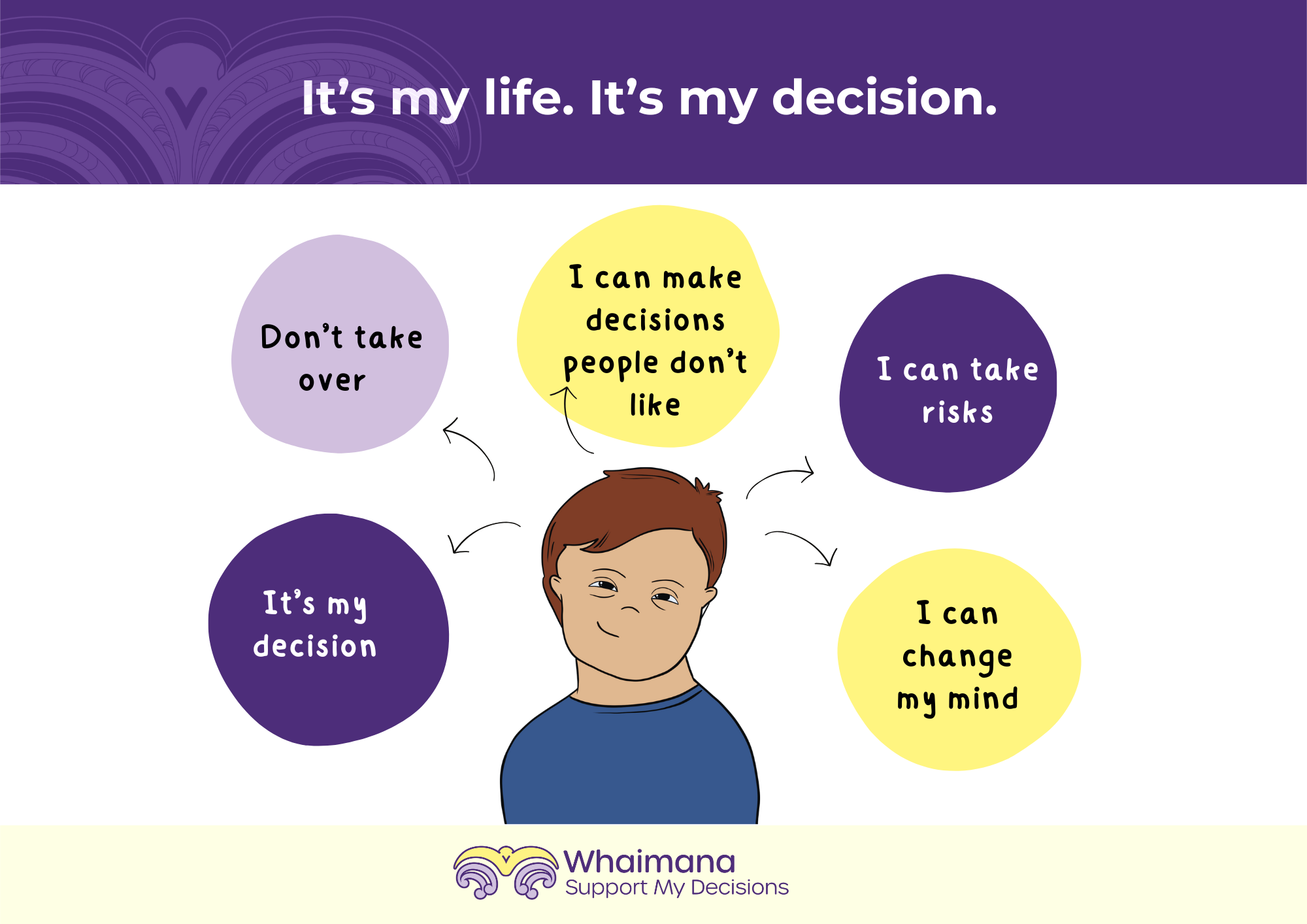
Download the It's my life, It's my decision poster
Alternate formats for this page
Caleb’s story
- Decision supporters can sometimes be firm. Supporters must always help the decision-makers to make decisions for themselves.
- Supporters need to listen well, be honest, caring and helpful.
- Caleb loves making decisions for himself. He enjoys having people support him. He wants all disabled people to be supported to achieve their dreams and goals.
Learn more from Caleb in this video. It is 1 minute and 40 seconds long.
Video transcript
You can be firm but you have also got to help us make decisions that benefit us. Don’t just say “You can’t do that” or ‘You can can’t do that”.
Be honest and caring and helpful and listen to us tāngata whaikaha (disabled people) because we know what we are talking about when we ask for support.
I love making decisions and having people help me. Basically, that’s what I always do with my staff and they always support me.
Norrie is my key person. She sits down with me and we go through all my finances and how much money I have got. And she says to me if you want to do this you are going to have to save for it – like my 40th birthday that’s coming up.
You can talk to them about anything. Like if I am struggling mental health wise, I can just talk to my staff or management.
When I make my own decisions, I feel happy because I know I am doing something for myself. It’s something that I have always wanted to set out to do.
If there are any kiritaki out there that are wanting to do that, talk to your staff or your management, wherever you are, and just say I want to do this, and they will help you do it. It worked for me.
Go out there and just achieve your dreams. If you’ve got something you want to do just talk to your staff or you managers. I have and I am still doing it now.
It is not about what the supporter thinks is best
Sometimes, supporters take over and make decisions based on what they think is in the person’s best interest.

Fred's story
Fred's wife died recently. His children noticed he seemed quieter than usual at a family dinner. The children were worried.
In their Facebook group chat, the children decided Fred needed more company. They didn’t think it was a good idea that Fred’s favourite hobby was going fishing on his own.
They signed Fred up for Lawn Bowls. They arranged for a grandson to move in to keep Fred company.
The children made these choices without asking Fred what he wanted. They thought they were helping but they were:
- ignoring Fred's wishes
- deciding what was best for him
- changing his life without his input
- removing his control.
Supported decision-making would help Fred to make his own decisions.
The decision-maker is in charge
In supported decision-making, when the person makes a decision:
- they are in control
- they choose what they want
- their life, their choice.
A good decision-supporter:
- helps, not controls
- does not push their own ideas
- listens to the person’s feelings
- accepts the person can take risks they understand. Safety matters, but control belongs to the person
- respects the person’s decision, even if the supporter doesn’t agree with it
- realises that people can change their mind. Sometimes we need to try things to figure out what we really want or need.
Alex's story
With the support of his family Alex decided to go flatting in a new suburb. After a while, Alex wanted to move.
Alex says that deciding where to live is a big decision and is not something people do every day. Alex talked to his Mum and Dad and family and they helped support his decision-making.
He decided to move back to his old suburb. He decided to live in a house with his sister and his niece. Alex enjoys living with them. He enjoys walking to the shops and the local area.
Checking for conflicts
Supporters must be honest with themselves.
- Do they have personal reasons for wanting a certain choice?
- Would the decision benefit them?
- Are they truly supporting the person's wishes?
It is not okay for a supporter to influence decisions so that they benefit themselves. To help avoid and spot undue influence:
- always ask: "Whose choice is this?"
- include several supporters
- step aside as the decision-supporter if there is a conflict. Tell other supporters about this conflict.
- keep communication clear
- respect the person's right to choose
- help the person to stay connected with their community.
Find out more
If you are worried about any form of abuse, you can ring a free helpline:
- Elder abuse helpline 0800 32 668 65.
- Adults at risk Personal Advocacy and Safeguarding Adults Trust (PASAT) 0800 728 70878.
- Are You Ok? Family violence helpline 0800 456 450.
- Oranga Tamariki (Ministry for Children) 0508 326 459.
If you are Deaf, hard of hearing, deafblind, speech impaired or find it hard to talk, you can use the New Zealand Relay Service external.
Visit our Safeguarding page for information on safeguarding people's rights, wellbeing, and safety
Alternate formats for this page: Always remember whose life it is
Audio (MP3 1.8MB)
Braille (BRF 3.5KB)
Easy Read (PDF 3.6MB) This is long. For this webpage only, see pages 27-37.
Large Print (Word 194KB)
Large Print (PDF 138KB)