Think about the options
The supporter may help the decision-maker to weigh up the different options.
Alternate formats for this page
Thinking about each option
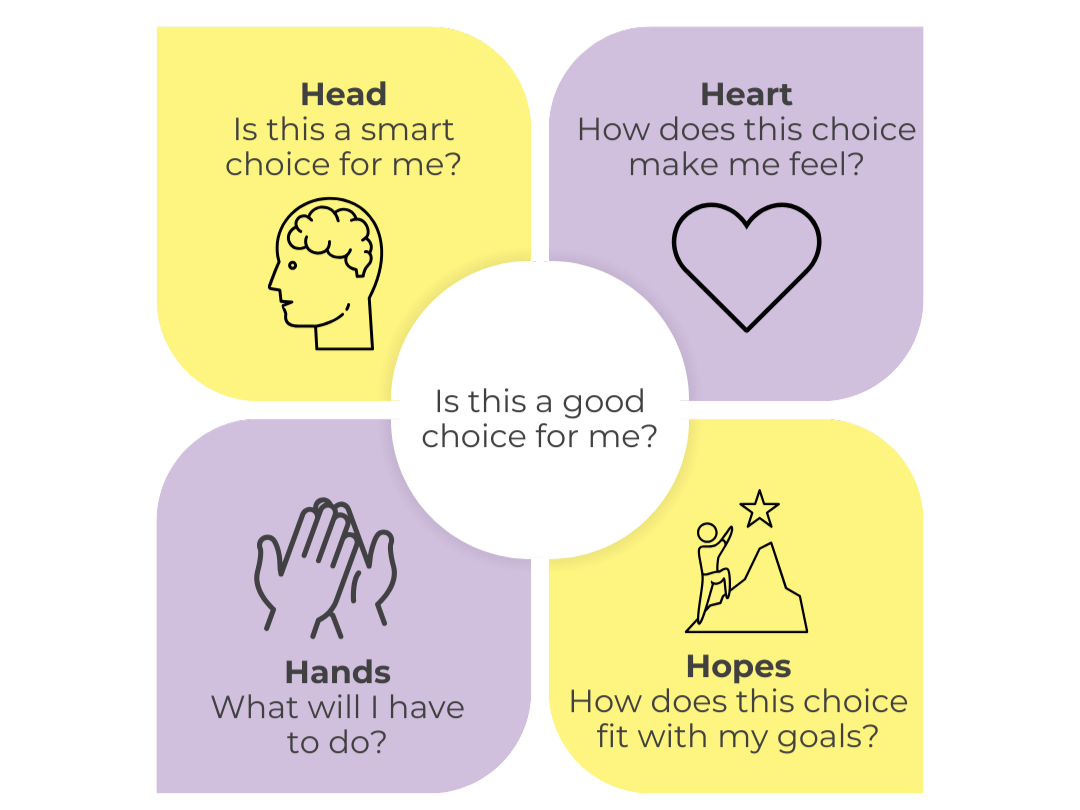
These different ways of looking at an option can help the decision-maker understand it is a good choice for them:
Head
- Is this a smart choice for me?
- What are the good things that might happen?
- What are the bad things that might happen?
- Can I reduce the risk of bad things happening?
Heart
- How does this choice make me feel?
Hands
- What will I have to do?
- How much time, effort, or cost will be involved?
- Will it involve other people?
Hopes
- How does it fit with my goals?
- How does it fit with the things that are important to me?
- How does it fit with what I want?
Comparing the options
You may like to make a Pros and Cons list together.
- You can draw a line down the middle of a page.
- One side of the page is the good things about the option.
- The other side is the bad things about the option.
Megan and Judy's story
Megan is a decision-maker. Judy is Megan's mum and decision-supporter.
- They make plans for what they are doing. They always have options in case something changes.
- They work on the options together so that Megan has choices.
- Making plans and having different options helps to reduce anxiety.
- Megan is happy and feels in control of her life. This makes life better for Judy too.
Learn more about Megan and Judy in this video. It is 2 minutes and 30 seconds long.
Video transcript
Life is a lot easier if you’re using supported decision-making because that means that the person you are working with understands what they are doing.
They understand the choices. They make the decision and feel in control of their life.
I think we have always had to work on supporting Megan to make decisions.
Megan is very strong-minded about what she wants to do. And sometimes, depending on how she is feeling, she will sometimes say hey let’s go and do this and then you sometimes have to negotiate times, but I think that choice is really important to Megan to whatever you do virtually.
There are times when Megan doesn’t want to do something and you go through the supported decision process and you realise actually what we want to do is not the right thing for her on that particular day or at that time, and you come up with some alternative solution.
It may be that you end up doing it on a different day or going down a completely different route.
You really have to unpick that. Megan won’t necessarily be able to articulate why it’s a no, but no I am not doing that. So you’ve actually got to sit down and talk to her and unpick what is going on.
One of the best things is having the plan A, plan B, plan C, which is a bit like well hey “We’re going to do this, but this might happen so plan B is this, and if that doesn't work we’ll have plan C.”
You work out plan A, B and C with Megan so then she knows what she’s doing and she’s had choice in deciding them and that actually reduces anxiety.
It makes my life a lot easier. Megan is an adult and she’s being treated like an adult and has choices and makes decisions in her life. And I think it lets her grow and gives her more responsibility.
Do supported decision-making. It’s so much more rewarding because the person you are working with will understand what you want to do. They understand their choices. They get to make a choice and they feel in control of their life.
This in turn grows their self-esteem and makes them proud of what they are doing.
Remember the big ideas
It is the decision-maker’s life.
- Weighing up the options is about what the decision-maker thinks, feels, and wants.
- It is not about what the supporter thinks is best.
Everyone has the right to take risks.
- Choices usually involve some risk.
- The supporter can help the decision-maker understand the risks.
- The decision-maker and supporter can think about ways to reduce the risk while still helping the decision-maker achieve what is important to them.
- If the person understands what might happen, their choice should generally be respected.
You can read more about these big ideas on the "What is Supported Decision-Making" page on this website.
Alternate formats for this page: Think about the options
Audio (MP3 1.2MB)
Braille (BRF 2.2KB)
Easy Read (PDF 5MB) This is long. For this page only see pages 56-62.
Large Print (Word 196KB)
Large Print (PDF 130KB)